Library advocacy blog featuring 21st century activities and technology.
Winter-Worldwide: Celebrating Multiple Cultures This Season!
Get link
Facebook
X
Pinterest
Email
Other Apps
Whether you celebrate Bohdi Day or Kwanzaa, this month's newsletter is stuffed with all sorts of goodies to make your holidays cheerful and bright! Enjoy!
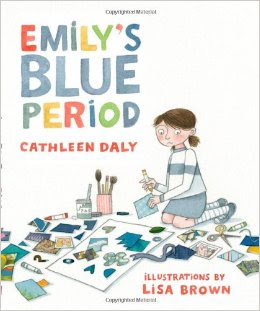
So I've come across the book Emily's Blue Period by Cathleen Daly with illustrations by Lisa Brown. It's a clever combination of my favorites: art, family, heart-felt emotions and perseverance. Without giving away too much Emily goes through a "blue" period to mimic her temporary obsession with Pablo Picasso (1881-1973) and to counteract the upheaval in her family. On a personal aside, I LOVE Picasso. Who else but he could divide his work into these distinct periods: The Blue Period (1901-1904), which were sad looking paintings using blue and blue-green colours. The Rose Period (1905-1907), which was a more happy style with orange and pink colours. The African- influenced Period (1908-1909) and The Cubism Period (1909- 1919). In my 30 seconds Book Talk : Emily's a young artist. She's impressionable in ways that make her uniqueness shine bright. However, she begins to mimic famed artist Pablo Picasso's "blue period" just when...
Hey y'all you may have read about my involvement with an ALA accredited equity case in Milwaukee: Then they rescinded the offer. I have a string of expletives a mile long. This chaos cost me the roof over my head, the earning potential for my family and provides another example of the high scrutiny Black female leaders endure, where the goal is to wield “an ugly and effective weapon to blunt the power of Black women, to suggest through word and attitude that she will never be enough, that she will never belong in the halls of power. ” But let's direct our focus on my response to the utter dumpster fire my life has blazed into because I chose to lead in my profession...again. 1. Degree biases and inequity. Saying that only ALA accreditation degree holders apply enforces a higher educational expense , shows an outward prejudice against near identical degree coursework and conflicts with an integral belief that librarians embrace: intellectual freedom, because it ...
Hey y'all. I've done some digging into our internet behaviors and how AI is learning our behavior online. Introducing Online Disinhibition Effect (ODE) , which in a nutshell is how differently we behave ONLINE versus IN REAL LIFE. Here's a more formal definition . Or you can watch the video below, as it's quite informative. Have you ever said something to a stranger online that you wouldn’t IRL? It could be because of the Online Disinhibition Effect. Find out more in this lesson + #AbovetheNoise video by @KQEDedspace for 11th graders. https://t.co/YxIa7jjiDB #K12 #digcit pic.twitter.com/o4z5xFYUEi — Common Sense Education (@CommonSenseEd) September 11, 2019 Part of my role as a librarian is to offer resources and lesson ideas as it relates to digital citizenship and online behaviors. This is the reason why I chose ODE to investigate. Online coversations are different from direct, face-to-face conversation in the following ways: 1. You can SEE each other...



Comments
Post a Comment